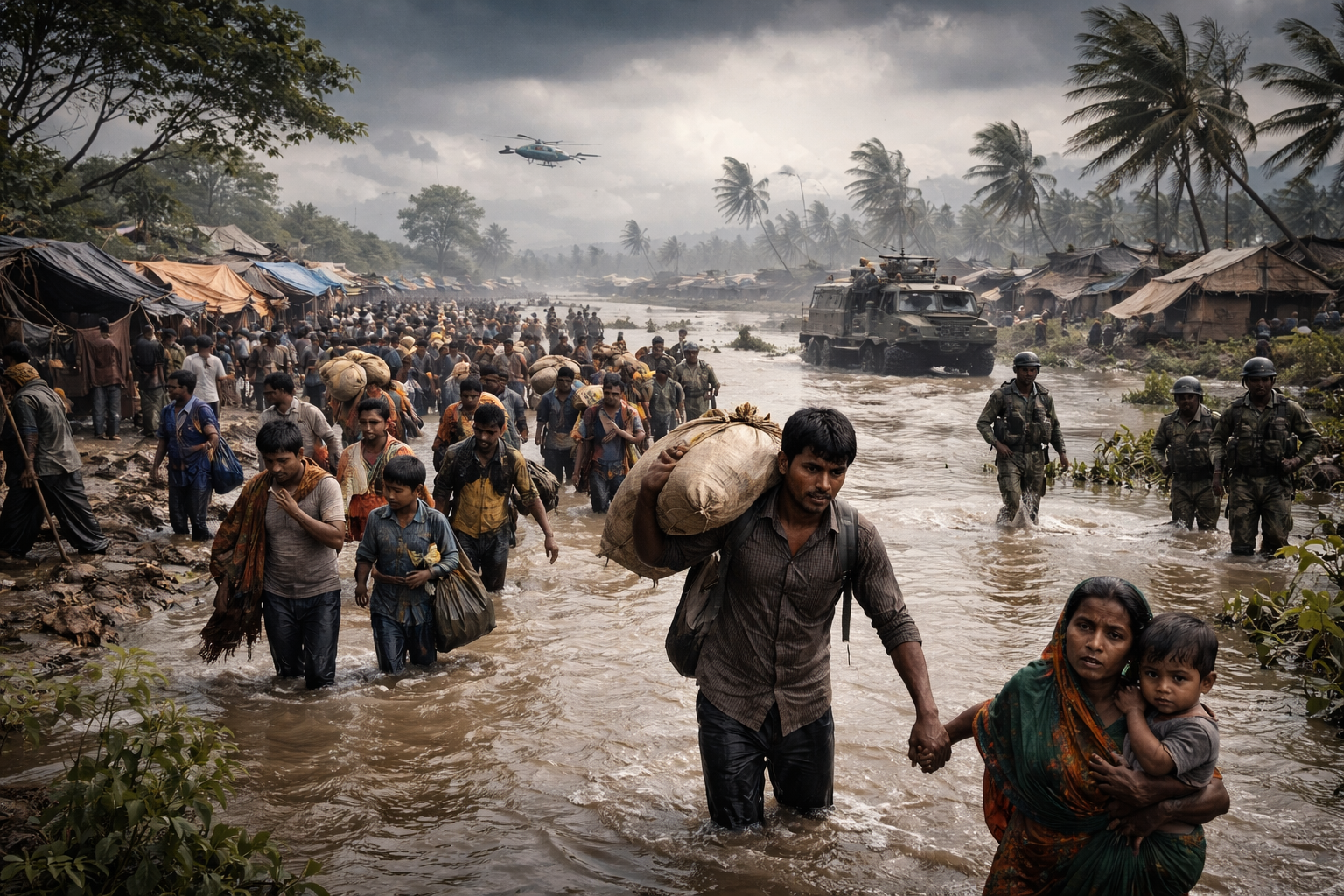

This case study investigates the nexus between climate-induced displacement and security in South Asia, challenging conventional border-centric security paradigms. We analyze how environmental stressors—coastal erosion, river flooding, and glacial melt—generate displacement patterns that transcend national boundaries, thereby reshaping regional security dynamics. The research employs a mixed-method approach, combining empirical case studies with policy analysis to interrogate the inadequacies of state-centric security models. Findings reveal that climate displacement often manifests as irregular cross-border migration or internal instability, with exclusionary border policies exacerbating human vulnerability while failing to address root causes. For example, coastal erosion displaces agrarian communities, forcing irregular migration that receiving states frame as a security threat, thereby intensifying border militarization. Moreover, internal displacement due to river flooding strains urban infrastructure, creating secondary security risks through resource competition and social friction. The study further identifies glacial melt as a catalyst for interstate tensions over shared water resources, highlighting how environmental degradation escalates geopolitical strain. Critically, the research argues that rigid border control frameworks are ill-suited to address climate-driven mobility, proposing instead adaptive strategies that recognize migration as an adaptation mechanism. Policy implications emphasize regional cooperation, resilience-based urban planning, and the integration of climate change into security discourse. The study contributes to broader debates on non-traditional security threats by demonstrating how climate displacement blurs the distinction between internal and external security, necessitating transformative governance approaches in South Asia and beyond.
1 Introduction
The intersection of climate change and security has emerged as a critical area of inquiry, particularly in regions where environmental stressors intersect with preexisting socioeconomic vulnerabilities. South Asia, characterized by dense populations, agrarian economies, and transboundary ecological systems, exemplifies this convergence. Existing literature frames climate-induced displacement as a “threat multiplier,”[1] amplifying instability through resource scarcity, forced migration, and geopolitical friction. However, traditional security paradigms remain anchored in state-centric models that prioritize territorial sovereignty over adaptive governance, a gap this research seeks to address.
The contribution of this study lies in its systematic examination of how climate displacement reconfigures security dynamics in South Asia. While prior work has explored regional climate-security linkages,[2] few studies interrogate the role of borders as contested sites where environmental and security imperatives collide. We advance this discourse by demonstrating how rigid border frameworks exacerbate human insecurity while failing to mitigate displacement drivers. For example, coastal erosion in deltaic regions displaces communities whose cross-border movement is criminalized, transforming a climate adaptation strategy into a perceived security threat.[3]
This research is guided by three key questions: (1) How do climate stressors generate displacement patterns with cross-border security implications? (2) What institutional blind spots prevent effective responses to climate-driven mobility? (3) How might border management evolve to address these challenges? The objective is to critique exclusionary security models and propose cooperative frameworks that reconcile mobility with stability.
The study builds on foundational work linking climate change to transnational security threats,[4] yet diverges by centering South Asia’s unique geopolitical context. Here, shared river systems and densely populated low-lying coasts create displacement pathways that transcend national boundaries. Recent analyses highlight how glacial melt and erratic monsoon patterns intensify these dynamics,[5] but few integrate these insights with border governance critiques.
2 Case Descriptions
The following cases illustrate how climate stressors in South Asia generate distinct displacement patterns, each with unique implications for regional security. These examples highlight the inadequacy of conventional border frameworks in addressing environmental mobility.
2.1 Coastal Erosion and Irregular Cross-Border Migration
Deltaic regions such as the Sundarbans and the Ganges-Brahmaputra-Meghna basin face accelerating land loss due to rising sea levels and intensified cyclonic activity. Saline intrusion renders agricultural land unproductive, displacing communities reliant on subsistence farming. Initial displacement is often internal, with affected populations relocating to urban peripheries. However, diminishing livelihood opportunities in overcrowded cities eventually push migrants toward international borders. For instance, displaced farmers from Bangladesh’s coastal zones increasingly cross into India’s northeastern states, where porous borders and informal labor markets facilitate irregular entry. State responses typically frame such movement as illegal migration, triggering heightened surveillance and securitization of border zones. This dynamic transforms climate refugees into perceived security threats, reinforcing exclusionary policies that neglect the environmental drivers of displacement.
2.2 River Flooding and Urban Instability
The Indus, Ganges, and Brahmaputra river systems exhibit heightened hydrological volatility, with monsoon rains causing recurrent, large-scale flooding. Annual displacements number in the millions, predominantly within national boundaries. For example, Pakistan’s 2022 floods displaced over 7 million people, many of whom relocated to Karachi and Hyderabad. Such inflows strain urban infrastructure, leading to the rapid expansion of informal settlements in flood-prone areas. Competition for housing, water, and employment exacerbates tensions between host communities and displaced groups, occasionally escalating into localized violence. Municipal authorities, already grappling with inadequate resources, struggle to manage these pressures, creating governance vacuums that non-state actors may exploit. Unlike cross-border displacement, this internal movement generates indirect security risks by eroding social cohesion and institutional capacity.
2.3 Glacial Melt and Transboundary Resource Tensions
The Hindu Kush Himalaya, which feeds South Asia’s major rivers, is experiencing glacial retreat at twice the global average rate. Downstream effects include short-term flood risks and long-term water scarcity, disrupting agrarian economies in northern India, Nepal, and Pakistan. Communities dependent on glacial meltwater for irrigation face livelihood collapse, prompting migration to urban centers or across borders. Simultaneously, dwindling water availability intensifies interstate competition over shared resources, particularly between India and Pakistan under the Indus Waters Treaty. This dual dynamic—local displacement and geopolitical strain—redefines borders as arenas of environmental conflict. Unlike traditional territorial disputes, these tensions stem from ecological interdependence, challenging security institutions to address non-military threats.
These cases collectively demonstrate how climate displacement erodes the distinction between internal and external security. Coastal erosion and glacial melt generate cross-border pressures, while river flooding destabilizes domestic governance structures. All three scenarios reveal the limitations of reactive border control in mitigating climate-driven mobility.
3 Findings and Discussion
The analysis of climate-induced displacement in South Asia reveals complex security challenges that transcend traditional state-centric frameworks, necessitating a reevaluation of existing governance approaches. The following sections explore these dynamics through legal, urban, environmental, and geopolitical lenses, highlighting the urgent need for adaptive and cooperative solutions.
3.1 Legal and Security Challenges in Climate Displacement
The absence of formal legal recognition for climate-displaced populations creates a protection gap that exacerbates human insecurity while generating new security dilemmas. Unlike refugees fleeing persecution under the 1951 Refugee Convention,[6] those displaced by environmental factors lack guaranteed rights to asylum or non-refoulement. This legal vacuum forces affected individuals into irregular migration channels, where they become vulnerable to exploitation and border criminalization. For example, Bangladeshi farmers displaced by saline intrusion often cross into India without documentation, where they face detention or deportation.[7]
Security institutions frequently respond to such movements with exclusionary measures rather than adaptive strategies. Border militarization in India’s northeastern states illustrates this trend, where fencing and increased patrols aim to deter irregular crossings but fail to address the underlying environmental drivers.[8] This securitization of climate mobility transforms humanitarian needs into perceived threats, reinforcing a cycle of vulnerability and repression. The Sundarbans region exemplifies this tension, as displaced communities navigating mangrove forests are framed as “illegal infiltrators” rather than victims of ecological collapse.[9]
Humanitarian-Security Collisions: Border zones become arenas where competing narratives of protection and sovereignty collide. While humanitarian actors advocate for safe migration corridors, security agencies prioritize territorial control, often disregarding the inevitability of climate-driven movement. This dichotomy is evident in the Bengal delta, where naval patrols intercept boats carrying displaced families, treating them as potential security risks rather than climate refugees.[10] Such responses contravene emerging norms on human mobility in climate change frameworks like the Global Compact for Migration.[11]
Legal Innovation Gaps: Existing international law remains ill-equipped to address cross-border climate displacement. The 2015 Paris Agreement acknowledges displacement risks but avoids binding commitments.[12] Regional initiatives like the South Asian Association for Regional Cooperation (SAARC) have similarly failed to institutionalize protection mechanisms, despite repeated calls for a coordinated approach.[13] This legal stagnation perpetuates ad hoc responses that prioritize short-term containment over long-term adaptation.
Normative Tensions: The securitization of climate migration reflects deeper contradictions in how states perceive environmental mobility. While climate adaptation policies increasingly recognize planned relocation as a strategy, cross-border movement remains stigmatized as a security threat.[14] This paradox underscores the need for legal frameworks that decouple climate displacement from criminality, potentially through regional agreements or amendments to refugee law. The Nansen Initiative’s Protection Agenda offers a template for such reforms, though its implementation in South Asia remains limited.[15]
The legal and security challenges examined here reveal systemic failures in addressing climate displacement as a structural rather than exceptional phenomenon. Without formal recognition of environmental mobility rights, states will continue to deploy exclusionary measures that heighten human vulnerability while failing to mitigate displacement drivers. This impasse demands innovative governance models that reconcile sovereignty with ecological interdependence.
3.2 Urban Insecurity and Governance Issues from Internal Displacement
The cascading effects of climate-induced internal displacement create profound urban security challenges that existing governance structures struggle to address. As rural populations flee environmental degradation, secondary cities across South Asia absorb disproportionate inflows, with Karachi, Dhaka, and Kathmandu experiencing particularly acute pressures. These urban centers, already burdened by inadequate infrastructure and weak institutional capacity, become sites of compounded vulnerability where environmental and social risks intersect.
Infrastructure Strain and Spatial Fragmentation: Unplanned settlements proliferate in hazardous zones such as floodplains or unstable hillsides, as displaced populations seek affordable shelter. In Dhaka, climate migrants constitute over 70% of slum dwellers, with many residing in areas prone to waterlogging and disease outbreaks.[16] This spatial segregation exacerbates inequality, as informal settlements lack access to clean water, sanitation, and emergency services. Municipal authorities often view these enclaves through a security lens, conducting periodic evictions that displace communities anew rather than addressing root causes.[17]
Resource Competition and Social Friction: The rapid influx of displaced populations intensifies competition for scarce urban resources, particularly water and housing. In Karachi, climate migrants from Sindh’s drought-affected regions compete with long-term residents for access to tanker water supplies, with conflicts frequently escalating into ethnic violence.[18] Such tensions reveal how environmental stress translates into social instability, particularly in cities with preexisting ethnic or political divisions. Governance failures amplify these effects, as weak land-use planning and corrupt allocation systems privilege powerful actors over vulnerable groups.[19]
Gendered Dimensions of Urban Insecurity: Women and girls face heightened risks in displacement-affected urban areas, with limited access to safe housing and increased exposure to gender-based violence. In Nepal’s Tarai region, flooding displaces entire households to urban peripheries where women experience restricted mobility and reduced livelihood opportunities.[20] These patterns underscore how climate migration reinforces existing inequalities, creating new security challenges that transcend traditional law-and-order frameworks.
Institutional Capacity Gaps: Local governments lack both the resources and the mandate to address climate displacement systematically. Urban planning documents rarely account for climate migration projections, while disaster management agencies focus on immediate relief rather than long-term integration.[21] This institutional mismatch is evident in Hyderabad, where post-flood resettlement programs have displaced communities to peripheral zones without livelihood options, perpetuating cycles of poverty and instability.[22]
Non-State Actor Proliferation: Governance vacuums in displacement-affected urban areas create opportunities for non-state actors to assume service provision roles. In Karachi’s Orangi Township, militant groups have capitalized on water shortages to build parallel governance structures, further eroding state authority.[23] Such dynamics demonstrate how climate-induced internal displacement can indirectly facilitate armed group recruitment and territorial control.
The urban security challenges examined here reveal a fundamental disconnect between climate adaptation and urban governance. Current approaches treat displacement as a temporary humanitarian crisis rather than a permanent feature of South Asia’s urban future. Addressing this gap requires transformative planning frameworks that anticipate migration flows, allocate resources equitably, and integrate displaced populations into urban systems. Without such reforms, secondary cities will remain pressure points where environmental and social instability converge.
3.3 Environmental Change and Interstate Tensions
The accelerating pace of environmental degradation in South Asia is reshaping interstate relations, with shared ecological systems becoming focal points for geopolitical competition. Unlike traditional security threats rooted in territorial disputes, these tensions emerge from the mismanagement of transboundary resources under climate stress, creating complex challenges that conventional diplomacy struggles to address.
Water Scarcity as a Conflict Multiplier: The Hindu Kush Himalayan glaciers, which feed South Asia’s major river systems, are retreating at unprecedented rates, altering water availability downstream. This phenomenon creates a paradox of simultaneous flood risks and long-term water scarcity, with profound implications for agrarian economies. The Indus River system exemplifies this tension, where reduced glacial meltwater intensifies competition between India and Pakistan under the strained Indus Waters Treaty framework.[24] Monitoring stations along the Chenab River have recorded 19% declines in dry-season flows since 2000, exacerbating irrigation shortages in Pakistan’s Punjab region while increasing India’s hydroelectric dam construction.[25] Such developments transform hydrological changes into political flashpoints, as seen in the 2019 Pulwama crisis where water disputes compounded broader hostilities.[26]
Borderlands as Ecological Hotspots: Environmental stress concentrates disproportionately in border regions, where governance gaps and competing jurisdictional claims hinder coordinated responses. The Sundarbans mangrove forest, straddling India and Bangladesh, illustrates how ecosystem collapse can escalate bilateral friction. As rising salinity destroys freshwater supplies, both countries have militarized forest patrols to prevent cross-border resource extraction, framing environmental adaptation strategies as security threats.[27] Satellite imagery reveals a 37% increase in border outposts since 2015, coinciding with declining fish stocks that previously sustained local communities.[28] This securitization of ecological management undermines traditional conservation approaches, replacing community-based resource sharing with exclusionary enforcement.
Climate Diplomacy Limitations: Existing regional institutions lack mechanisms to address environment-driven tensions. SAARC’s 2010 Thimphu Statement on Climate Change recognized shared vulnerabilities but failed to establish binding cooperation frameworks.[29] Subsequent initiatives like the Bangladesh-Bhutan-India-Nepal (BBIN) Motor Vehicles Agreement prioritized economic integration over ecological interdependence, overlooking how transportation corridors intersect with fragile watersheds.[30] This institutional gap becomes critical as glacial melt alters river courses, potentially invalidating existing boundary demarcations along the India-China Line of Actual Control.[31]
Non-Traditional Security Paradigms: The evolving nature of climate-driven tensions demands reconceptualization of security institutions. Military strategists increasingly identify water scarcity as a “threat multiplier” in defense assessments, yet operational responses remain focused on border hardening rather than adaptive governance.[32] The 2021 Indian Army Doctrine notably incorporated climate change risks but maintained traditional territorial defense postures, illustrating the conceptual lag in addressing environmental security challenges.[33]
Data Gaps and Monitoring Challenges: Asymmetric information flows exacerbate interstate distrust, particularly regarding shared water resources.[34] Similarly, Pakistan’s objections to Indian hydroelectric projects stem partly from inadequate technical consultations under the Indus Treaty’s conflict resolution mechanisms.[35]
The environmental change-interstate tension nexus reveals fundamental flaws in South Asia’s security architecture. By treating ecological interdependence as a zero-sum competition rather than a shared challenge, states perpetuate cycles of mistrust that undermine regional stability. Addressing this requires innovative diplomacy that prioritizes joint monitoring systems, adaptive water-sharing agreements, and the demilitarization of conservation zones. Without such reforms, climate change will continue to erode the foundations of interstate cooperation in this strategically vital region.
3.4 Impact of Climate-Induced Displacement on South Asia’s Security Landscape
The cumulative effects of climate-induced displacement are fundamentally altering South Asia’s security architecture, eroding traditional distinctions between internal and external threats while exposing the limitations of state-centric response mechanisms. As demonstrated by the case studies, environmental stressors generate displacement patterns that simultaneously challenge domestic governance structures and cross-border stability frameworks, creating complex security dilemmas that defy conventional categorization.
Blurring of Security Domains: The conventional separation between internal security (maintaining law and order) and external security (border defense) becomes increasingly untenable as climate displacement creates hybrid threats. For instance, coastal erosion in Bangladesh generates cross-border migration that Indian security forces treat as an external threat, while simultaneously straining West Bengal’s internal capacity to manage population inflows.[36] This convergence is particularly evident in border regions like Assam, where climate migrants are framed as both “illegal infiltrators” and catalysts for local resource conflicts.[37] Security institutions, structured around rigid jurisdictional divisions, struggle to address these interconnected challenges through singular operational paradigms.
Non-Linear Threat Escalation: Unlike traditional security threats with identifiable actors and clear escalation pathways, climate displacement generates diffuse risks that propagate through social and economic systems. The 2022 Pakistan floods exemplify this dynamic, where initial displacement triggered secondary security effects including urban unrest, healthcare system collapse, and armed group recruitment in Balochistan.[38] Such cascading impacts reveal how environmental shocks can bypass conventional early warning systems, overwhelming institutional response capacities before threats are fully recognized.
Sovereignty Paradoxes: Climate displacement exposes contradictions in how states exercise territorial control. While governments assert sovereignty through border hardening (e.g., India’s border fencing with Bangladesh), they simultaneously fail to protect populations within their borders from climate impacts.[39] This creates a perverse dynamic where states invest more in excluding displaced people than in preventing the conditions that force displacement. The Sundarbans region illustrates this tension, as both India and Bangladesh prioritize border patrols over mangrove conservation, despite the latter being more effective at preventing climate-driven migration.[40]
Human Security Erosion: Traditional security frameworks prioritize state stability over individual wellbeing, often exacerbating vulnerabilities for displaced populations. In Nepal’s Himalayan regions, glacial retreat has displaced herding communities who face arrest when crossing international borders for pasture, despite having no alternative livelihood options.[41] This criminalization of survival strategies reveals how rigid security approaches can undermine the very populations they purport to protect.
Institutional Adaptation Gaps: Security sector institutions remain poorly equipped to address the temporal dimensions of climate displacement. Unlike sudden conflict-induced displacement, climate migration often occurs gradually, allowing policymakers to defer action until crises erupt. The Ganges-Brahmaputra delta has seen salinity intrusion displace communities over decades, yet regional security planning continues to treat such movements as exceptional rather than inevitable.[42] This temporal mismatch between environmental change and institutional response creates persistent governance gaps.
Emerging Security Paradigms: Some security actors are beginning to recognize climate displacement as a structural rather than episodic challenge. The Bangladesh Armed Forces’ inclusion of climate scenarios in military exercises represents tentative progress, though operational doctrine remains focused on traditional threats.[43] Similarly, India’s National Disaster Management Authority has expanded its mandate to include climate migration planning, but lacks coordination with border security agencies.[44]
The transformation of South Asia’s security landscape demands fundamental reevaluation of institutional priorities and operational frameworks. Climate displacement does not merely represent another security challenge to be added to existing agendas—it necessitates reimagining the very foundations of how security is conceptualized and implemented in an era of environmental breakdown. The following section explores how adaptive and cooperative approaches might address these systemic challenges.
3.5 Need for Adaptive and Cooperative Border Frameworks
The inadequacy of traditional border control mechanisms in addressing climate-induced displacement necessitates a paradigm shift toward adaptive governance models that recognize mobility as an essential adaptation strategy. Rigid border regimes predicated on exclusion and deterrence fail to account for the inevitability of climate-driven migration, often exacerbating human insecurity while doing little to mitigate underlying environmental stressors. Emerging research demonstrates that flexible border management approaches yield superior outcomes in regions experiencing climate displacement pressures.[45]
Mobility as Adaptation: Empirical evidence from South Asia’s climate hotspots reveals that migration frequently serves as a rational response to environmental degradation rather than a security threat. In the Bengal delta, seasonal labor migration patterns have long functioned as a coping mechanism for agricultural disruptions caused by salinity intrusion.[46] However, contemporary border policies criminalize these traditional mobility pathways, forcing displaced populations into irregular channels that heighten vulnerability to exploitation. Recognizing migration as a legitimate adaptation strategy would require legal frameworks that permit temporary or circular movement across borders during environmental stress periods, similar to the ECOWAS protocol on free movement in West Africa.[47]
Regional Cooperation Mechanisms: Effective responses to climate displacement demand institutionalized cooperation that transcends bilateral tensions. The Himalayan river systems exemplify this imperative, where glacial melt affects multiple downstream states simultaneously. A potential model exists in the Mekong River Commission’s data-sharing and joint planning mechanisms, which could be adapted to South Asian contexts despite geopolitical complexities.[48] SAARC’s dormant Climate Change Center could be revitalized to coordinate displacement forecasting and resource allocation, moving beyond its current limited role in information exchange.[49]
Integrated Early Warning Systems: Technological advancements enable more sophisticated prediction of displacement triggers, yet these tools remain disconnected from border management strategies. Satellite monitoring of coastal erosion in the Sundarbans, for instance, provides 12-18 month lead times on potential displacement events, but this data rarely informs border security preparations.[50] Linking such systems to adaptive border protocols could enable preemptive humanitarian corridors or temporary protection arrangements, reducing chaotic migration scenarios that often trigger securitized responses.
Community-Based Border Governance: Top-down border enforcement frequently disregards local cross-border networks that have historically managed environmental variability. In the Thar Desert region straddling India and Pakistan, traditional pastoralist communities developed intricate water-sharing arrangements that contemporary border policies now disrupt.[51] Empowering local institutions to manage climate-driven mobility through community visa programs or cross-border resource cooperatives could mitigate tensions while preserving ecological knowledge.
Security Sector Reform: Border security agencies require retraining to distinguish between climate-displaced populations and conventional security threats. Pilot programs in Nepal’s border districts have shown promise by incorporating climate literacy into border guard training, reducing violent confrontations with displaced herders.[52] Such initiatives must be scaled regionally, with joint exercises simulating climate migration scenarios to build interoperability among South Asian security forces.
Legal Innovation Pathways: Existing international frameworks provide foundations for progressive reform. The Global Compact on Refugees explicitly references climate drivers of displacement, offering a normative basis for regional protection agreements.[53] Similarly, the Sendai Framework’s emphasis on cross-border disaster risk reduction could be operationalized through SAARC to address slow-onset climate impacts.[54]
Economic Integration Leverage: Climate displacement pressures create unexpected opportunities for deeper regional economic cooperation. The BBIN Motor Vehicles Agreement could be expanded to include provisions for labor mobility during climate shocks, pairing infrastructure development with adaptive migration pathways.[55] Such economic incentives may overcome political resistance to border flexibility, as seen in the EU’s visa facilitation policies for neighboring climate-vulnerable states.[56]
The transition from rigid border control to adaptive management requires confronting entrenched security paradigms that equate sovereignty with exclusion. South Asia’s experience demonstrates that climate displacement cannot be stopped by physical barriers or punitive measures—it can only be managed through cooperative frameworks that acknowledge ecological interdependence. While political obstacles remain substantial, the costs of inaction increasingly outweigh the risks of innovation in border governance. The region’s future stability hinges on its ability to reimagine borders as dynamic interfaces for managing shared environmental challenges rather than static lines of defense against inevitable human mobility.
4 Conclusion
This study has demonstrated how climate-induced displacement in South Asia fundamentally challenges conventional security paradigms by blurring the boundaries between internal and external threats. The research reveals that environmental stressors—coastal erosion, river flooding, and glacial melt—generate complex displacement patterns that transcend national borders while simultaneously destabilizing domestic governance structures. A key contribution lies in exposing the limitations of state-centric security models that criminalize climate mobility rather than addressing its root causes. The findings underscore that rigid border control mechanisms not only fail to prevent displacement but often exacerbate human insecurity while neglecting the ecological interdependencies that drive regional instability. Looking ahead, the study highlights an urgent need for research that bridges the gap between climate adaptation and security policy. Future investigations should explore how regional institutions can operationalize adaptive border management in politically contested environments, particularly through joint early warning systems and community-based governance models. The broader implications suggest that South Asia’s experience offers critical lessons for other climate-vulnerable regions, where environmental change is similarly reshaping security landscapes. Addressing these challenges requires moving beyond traditional notions of sovereignty to develop cooperative frameworks that recognize human mobility as an inevitable and necessary response to ecological transformation.
[1] HJ Schellnhuber, Climate Change as a Security Risk (api.taylorfrancis.com, 2010).
[2] ANM Muniruzzaman, “Climate Change and Regional Security,” Bipss Publication, 2012.
[3] R Karim and TA Jannati, “Climate-Induced Migration and Its Threat to National Security: Implications for Regional Stability and Geopolitics in South Asia,” Handbook of Migration, International Relations and Geopolitics, 2025.
[4] C Jasparro and J Taylor, “Climate Change and Regional Vulnerability to Transnational Security Threats in Southeast Asia,” Geopolitics, 2008.
[5] S Saeed, “The Impact of Climate Change on Global Power Dynamics,” International Journal of Policy Studies, 2024.
[6] J McAdam, “The Enduring Relevance of the 1951 Refugee Convention,” International Journal of Refugee Law, 2017.
[7] M Nevitt, “Climate Change and the Specter of Statelessness,” Geo. Env’t L. Rev., 2022.
[8] HJ Shewly, “Introduction: Migration, Power, and Security in South Asia,” Handbook of Migration, International Relations and Security, 2025.
[9] A Ghose and SM Ali, Displaced by Rising Tides: Legal Insights and Policy Imperatives for Climate Refugees in the Sundarbans Region of India (diamond-oa.lib.cam.ac.uk, 2024).
[10] R Chakraborty, “Climate Change and Maritime Security in the Bay of Bengal: A Case Study of Coastal Communities of West Bengal and Bangladesh,” The Routledge Handbook of Maritime India, 2025.
[11] UNG Assembly, “Global Compact for Safe, Orderly and Regular Migration,” International Journal of Refugee Law, 2018.
[12] C Ney, “Making a Place for Climate-Impacted Displacement in the Paris Climate Accord,” Lincoln Planning Review, 2017.
[13] ASMA Ullah, “Regional Organisations and Migration Governance in South Asia: Navigating Complexities Among SAARC Member Countries,” Handbook of Migration, International Relations and Global Governance, 2025.
[14] NL Bonnett and SJ Birchall, “Local Planning for Climate Induced Relocation: A Systematic Review,” International Journal of Disaster Risk Reduction, 2025.
[15] J McAdam, “From the Nansen Initiative to the Platform on Disaster Displacement: Shaping International Approaches to Climate Change, Disasters and Displacement,” UNSWLJ, 2016.
[16] N Adri, ’Climate-Induced’rural-Urban Migration in Bangladesh: Experience of Migrants in Dhaka City (academia.edu, 2015).
[17] SA Wahab and I Ashutosh, “Rebordering South Asia: Displaced Persons and Urbanization,” Annals of the American Association of Geographers, 2022.
[18] HF Khan and SA Arshad, “Beyond Water Scarcity: Water (in) Security and Social Justice in Karachi,” Journal of Hydrology: Regional Studies, 2022.
[19] N Anwar and M Sur, Climate Change, Urban Futures, and the Gendering of Cities in South Asia (opendocs.ids.ac.uk, 2021).
[20] S Shrestha, IMPACT OF CLIMATE CHANGE INDUCED DISPLACEMENT FROM THE GENDER PERSPECTIVE IN DARCHULA DISTRICT, NEPAL (academia.edu, 2026).
[21] R Ahsan, S Karuppannan, and J Kellett, “Climate Migration and Urban Planning System: A Study of Bangladesh,” Environmental Justice, 2011.
[22] E Orhan, “The Consequences of Security Cognition in Post-Disaster Urban Planning Practices in the Case of Turkey,” Natural Hazards, 2015.
[23] R Schweiger, “The Role of Non-State Actors and Cities in Global Migration and Refugee Governance,” IntechOpen, 2024.
[24] FU Haq, I Ahmad, and NM Khan, “Climate Change, Water Variability, and Cooperation Along Transboundary River Basins in Perspective of Indus Water Treaty,” The Water, Climate, And Food Nexus, 2024.
[25] AK Biswas, “Cooperation or Conflict in Transboundary Water Management: Case Study of South Asia,” Asian Perspectives on Water Policy, 2013.
[26] MN Mirza, Indus Water Disputes and India-Pakistan Relations (archiv.ub.uni-heidelberg.de, 2016).
[27] K Hassan et al., “Climate Change and World Heritage: A Cross-Border Analysis of the Sundarbans (Bangladesh–India),” Journal of Policy Research in Tourism, Leisure and Events, 2019.
[28] B Jackson et al., “Remote Sensing of Fish-Processing in the Sundarbans Reserve Forest, Bangladesh: An Insight into the Modern Slavery-Environment Nexus in the Coastal Fringe,” Maritime Studies, 2020.
[29] MS Islam and E Kieu, “Climate Change and Food Security in SAARC,” Climate Change And Food Security In Asia Pacific, 2021.
[30] P Pal, “Intra-BBIN Trade: Opportunities and Challenges,” ORF Issue Brief, 2016.
[31] L Vemsani, “The Himalayan Ranges, Glaciers, Lakes and Rivers: An International Ecological, Economic and Military Outlook,” The Political Economy of Conflict in South Asia, 2015.
[32] AJ Tellis, “The Changing Political-Military Environment: South Asia,” Unable to Determine, 2001.
[33] D Jayaram, “The Indian Military and Environmental Affairs: An Analysis Through the Lens of Military Change,” Contemporary South Asia, 2020.
[34] A Barua, S Vij, and M Zulfiqur Rahman, “Powering or Sharing Water in the Brahmaputra River Basin,” International Journal of Water Resources Development, 2018.
[35] WA Qureshi, “Dispute Resolution Mechanisms: An Analysis of the Indus Waters Treaty,” Pepp. Disp. Resol. LJ, 2018.
[36] R McLeman, “International Migration and Climate Adaptation in an Era of Hardening Borders,” Nature Climate Change, 2019.
[37] S Sushil, Climate Change an Emerging Threat to Peace and Security in Assam (North-East India): A Political Ecology Approach (etheses.whiterose.ac.uk, 2024).
[38] HB Waseem and IA Rana, “Floods in Pakistan: A State-of-the-Art Review,” Natural Hazards Research, 2023.
[39] S Dalby, “Bordering Sustainability in the Anthropocene,” Territory, Politics, Governance, 2020.
[40] J Vivekanandan, “Scratches on Our Sovereignty?: Analyzing Conservation Politics in the Sundarbans,” Regions and Cohesion, 2021.
[41] P Gentle and R Thwaites, “Transhumant Pastoralism in the Context of Socioeconomic and Climate Change in the Mountains of Nepal,” Mountain Research and Development, 2016.
[42] D Lund, “Navigating Slow-Onset Risks Through Foresight and Flexibility in Fiji: Emerging Recommendations for the Planned Relocation of Climate-Vulnerable Communities,” Current Opinion in Environmental Sustainability, 2021.
[43] LCK Akbar, “Climate Change and Bangladesh: Role of Military in Pursuing Non-Military Security Interests,” NDC E-JOURNAL, 2015.
[44] D Gupta et al., “Climate-Induced Migration in India and Bangladesh: A Systematic Review of Drivers, Impacts, and Adaptation Mechanisms,” Climate, 2025.
[45] McLeman, “International Migration and Climate Adaptation in an Era of Hardening Borders.”
[46] T Siddiqui et al., Accommodating Migration in Climate Change Adaptation: A GBM Delta Bangladesh Perspective (idl-bnc-idrc.dspacedirect.org, 2018).
[47] EO Ochoga, GU Osimen, and IE Pokubo, “Assessing the Security Implications of the ECOWAS Protocol on Free Movement in Nigeria,” Unable to Determine the Complete Publication Venue, 2025.
[48] D Li, J Zhao, and RS Govindaraju, “Water Benefits Sharing Under Transboundary Cooperation in the Lancang-Mekong River Basin,” Journal of Hydrology, 2019.
[49] RK Singh and M Kumar, “Assessing Vulnerability of Agriculture System to Climate Change in the SAARC Region,” Environmental Challenges, 2021.
[50] E Hossain et al., “Big Data and Migration Forecasting: Predictive Insights into Displacement Patterns Triggered by Climate Change and Armed Conflict,” Unable to Determine the Complete Publication Venue, 2023.
[51] G Rodriguez, Borderland Empires: An Indigenous Phenomenon (search.proquest.com, 2025).
[52] McLeman, “International Migration and Climate Adaptation in an Era of Hardening Borders.”
[53] TA Aleinikoff, “The Unfinished Work of the Global Compact on Refugees,” International Journal of Refugee Law, 2018.
[54] D Kanteler and I Bakouros, “A Collaborative Framework for Cross-Border Disaster Management in the Balkans,” International Journal of Disaster Risk Reduction, 2024.
[55] E Weber, “Trade Agreements, Labour Mobility and Climate Change in the Pacific Islands,” Regional Environmental Change, 2017.
[56] D Butros, VB Gyberg, and A Kaijser, “Solidarity Versus Security: Exploring Perspectives on Climate Induced Migration in UN and EU Policy,” Environmental Communication, 2021.
Yabing Zhang is affiliated with the School of Foreign Languages at Peking University. Her academic work focuses on language, culture, communication, and climate. She can be reached at zhangyabing@pku.edu.cn.
Usman Umer is affiliated with the Department of Media and Communication at Government Associate College Sharaqpur. His interests include media studies, communication research, and environment. He can be contacted at usmanumer09@gmail.com.