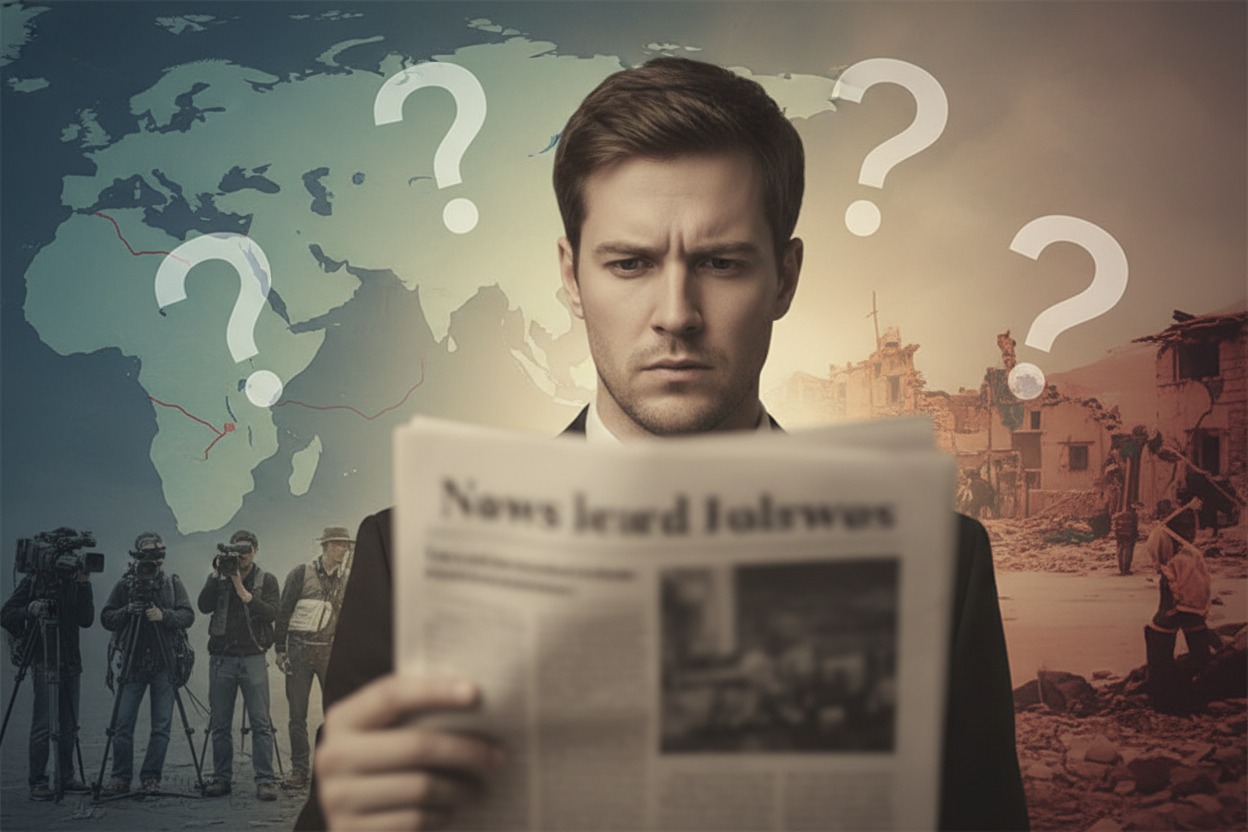

When there is a war or crisis in Africa, Asia, or Latin America, most people read about it in Western newspapers. These papers are from Europe or North America. They have a lot of money and power. But their stories often miss important parts. They might leave out history. They might only talk to leaders, not normal people. This commentary gives readers five simple questions to ask when they read these stories. These questions help us see the full picture. They help us understand the pain and the truth of the Global South. This is not about hating Western media. It is about reading with open eyes.
Introduction: The Story We See
Turn on the television. Open a news app. You see a headline: “Violence Erupts in Sudan” or “Crisis in Yemen.”[1] The story talks about bombs, numbers of dead, and big political leaders. It feels urgent. It feels serious.
But something is missing. You do not hear the voices of mothers who lost children. You do not hear about the history of why the fighting started. You do not hear about the people who are trying to build peace.[2]
Western media is powerful. It shapes how the world sees problems. But it often sees the Global South through a narrow lens. It sees victims, not survivors. It sees chaos, not complexity.[3] As readers, we do not have to accept every story as the full truth. We can learn to read between the lines.
This commentary offers five simple questions. Use them when you read about conflicts in the Global South. They will help you find the missing pieces.
Question 1: Who Is Speaking?
The first thing to check is the source. Who is giving the information?[4]
In many Western reports, the sources are officials. They are generals, politicians, or experts from big universities in the West. They speak in formal language. They talk about strategy and borders.
But where are the local people? Where are the teachers, the shopkeepers, the farmers?[5] They are the ones living through the conflict. They know what is really happening. If a story only quotes officials, it is only half a story.
What to do: Look for names of local people. If you do not see them, know that the story is incomplete. Search for local news sites to hear their side.
Question 2: Where Is the Reporter?
Location matters. Is the reporter standing in the capital city? Or are they in the village where the fighting is?[6]
Many Western news agencies have offices in big cities like London or New York. They send reporters to the Global South only when there is big violence. They stay in safe hotels. They do not walk the streets.[7]
This creates a distance. The story feels cold. It feels like a video game, not real life. A reporter who lives in the region understands the culture. They know the language. They know the fear.
What to do: Check the byline. Where is the writer based? If they are flying in for two days, take their story with a grain of salt. Look for reports from journalists who live there.
Question 3: What Is the History?
Conflicts do not start overnight. They have roots.[8] But Western media often treats them like sudden storms. They say, “Violence broke out today.” This makes it seem random. It makes the people seem naturally violent.
This is not true. Most conflicts have a long history. Maybe there was a war ten years ago. Maybe there was colonial rule fifty years ago. Maybe there is a fight over water or land.[9]
When history is missing, the blame falls on the wrong people. It looks like one group is just “bad.” But usually, both sides have grievances.
What to do: Ask yourself: “What happened before this?” If the article does not say, look for a background piece. Do not judge the present without knowing the past.
Question 4: Who Is the Victim?
How are the people shown in the pictures? Are they shown as helpless victims?[10]
Western media loves images of suffering. They show crying children or ruined homes. This makes people feel sad. It makes them donate money. But it also takes away power. It makes the locals look like they cannot help themselves.[11]
It ignores the people who are feeding their neighbors. It ignores the doctors working without electricity. It ignores the activists demanding change. These people are not just victims. They are agents of change.
What to do: Look for stories of strength, not just pain. Who is solving the problem? If everyone looks helpless, the story is biased.
Question 5: What Is the Solution?
Finally, look at the ending. Does the story suggest a solution?[12]
Often, Western media suggests that outside help is the only answer. They say, “The UN must step in” or “Western countries should send aid.” This implies that locals cannot fix their own problems.[13]
But local communities often have their own ways to make peace. They have elders, councils, and traditions. These are often ignored by international planners.[14]
What to do: Ask: “Who is fixing this?” If the only heroes are foreigners, the story is incomplete. Real peace comes from within.
Why This Matters
You might ask: “Why does this matter? I just want to know the news.”
It matters because stories shape policy. When Western leaders read these stories, they make decisions. They send weapons. They send aid. They impose sanctions.[15] If the stories are wrong, the decisions are wrong.
It also matters for dignity. People in the Global South are tired of being seen as problems. They want to be seen as partners. They want to be heard.[16]
As readers, we have power. When we ask these five questions, we demand better journalism. We tell editors that we want the full truth. We support the idea of knowledge “Beyond Western Frames.”
Conclusion: Be a Smart Reader
You do not need to be an expert to read critically. You just need to be curious.
Next time you read a headline about a conflict in the Global South, pause. Ask the five questions:
- Who is speaking?
- Where is the reporter?
- What is the history?
- Who is the victim?
- What is the solution?
If the answers are missing, do not stop there. Search for local voices. Read regional newspapers. Listen to community radio. The truth is not just in the big Western papers. It is in the streets, the villages, and the voices of the people. By seeking them out, we honor their humanity. We build a world where everyone’s knowledge counts.
[1] Edward Said, Covering Islam: How the Media and the Experts Determine How We See the Rest of the World (New York: Pantheon Books, 1981), 3.
[2] Chinua Achebe, “An Image of Africa: Racism in Conrad’s Heart of Darkness,” Massachusetts Review 18, no. 4 (1977): 782.
[3] Teun A. van Dijk, News as Discourse (Hillsdale: Lawrence Erlbaum Associates, 1988), 55.
[4] Howard Friel and Richard Falk, The Israel-Palestine Conflict: One Hundred Years of War (Cambridge: Cambridge University Press, 2006), 12.
[5] Gayatri Chakravorty Spivak, “Can the Subaltern Speak?” in Marxism and the Interpretation of Culture, ed. Cary Nelson and Lawrence Grossberg (Urbana: University of Illinois Press, 1988), 271.
[6] Mark Pedelty, War Stories: The Culture of Foreign Correspondents (New York: Routledge, 1995), 89.
[7] Susan Moeller, Compassion Fatigue: How the Media Sell Disease, Famine, War and Death (New York: Routledge, 1999), 45.
[8] Mahmood Mamdani, Good Muslim, Bad Muslim: America, the Cold War, and the Roots of Terror (New York: Pantheon, 2004), 15.
[9] Pankaj Mishra, From the Ruins of Empire: The Intellectuals Who Remade Asia (New York: Farrar, Straus and Giroux, 2012), 20.
[10] Lila Abu-Lughod, “Do Muslim Women Really Need Saving? Anthropological Reflections on Cultural Relativism and Its Others,” American Anthropologist 104, no. 3 (2002): 785.
[11] Teju Cole, “The White-Savior Industrial Complex,” The Atlantic, March 21, 2012, https://www.theatlantic.com/international/archive/2012/03/the-white-savior-industrial-complex/254843.
[12] Roland Marchand, Creating the Third Force: Indigenous Processes of Peacemaking (Lanham: Lexington Books, 2013), 5.
[13] James C. Scott, Seeing Like a State: How Certain Schemes to Improve the Human Condition Have Failed (New Haven: Yale University Press, 1998), 340.
[14] John Paul Lederach, The Moral Imagination: The Art and Soul of Building Peace (Oxford: Oxford University Press, 2005), 60.
[15] Noam Chomsky and Edward S. Herman, Manufacturing Consent: The Political Economy of the Mass Media (New York: Pantheon, 1988), 2.
[16] Boaventura de Sousa Santos, The End of the Cognitive Empire: The Coming of Age of Epistemologies of the South (Durham: Duke University Press, 2018), 10.
Ramla Sehrai is affiliated with Government Graduate College for Women Satiana Banglow, Faisalabad, Pakistan. Her academic interests include education and social studies. She can be contacted at saif.niazi72@gmail.com.